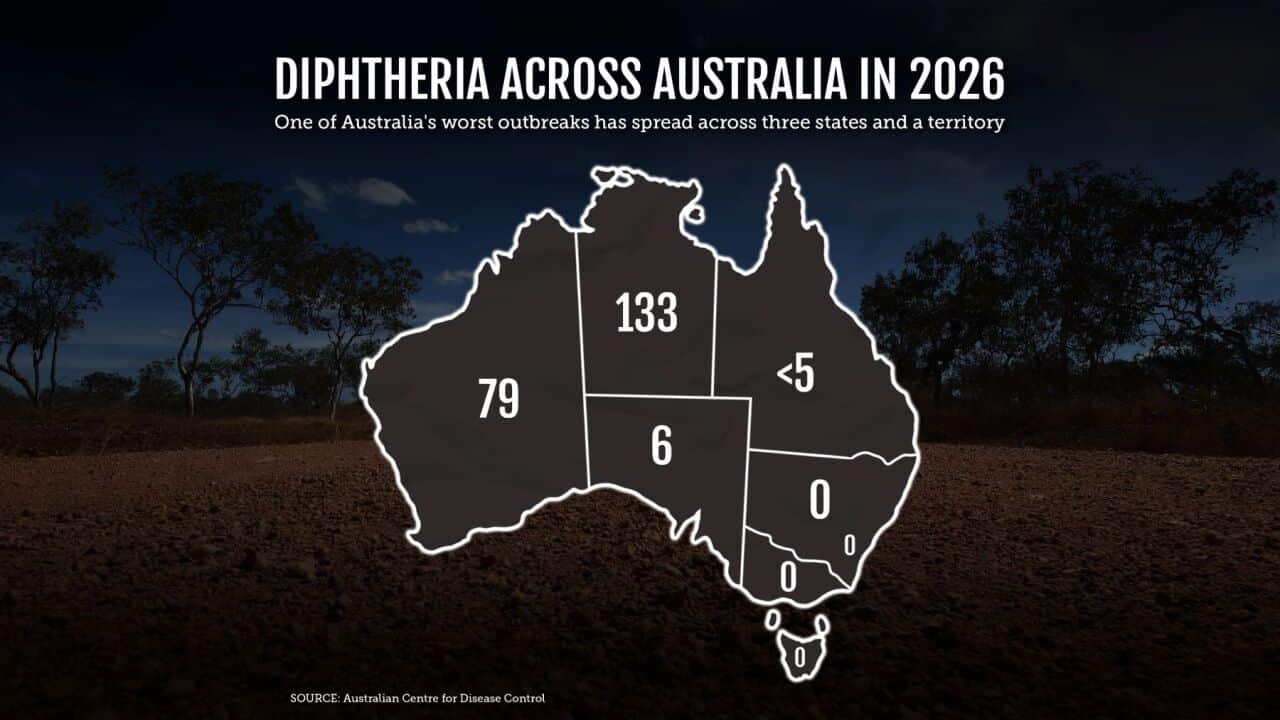

Australia's worst diphtheria outbreak in decades has spread across Northern Territory into Western Australia, Queensland and South Australia, with more than 230 [[as of May 21]] cases of the disease reported so far this year. Aboriginal Community Controlled Health Organisations and health workers are welcoming a $7 million federal government funding package aimed at supporting the response to the outbreak. But, experts say the re-emergence of the disease exposes serious gaps in the public health system.
Listen to Australian and world news, and follow trending topics with SBS News Podcasts.
TRANSCRIPT:
Australia is experiencing its worst diphtheria outbreak in decades, with more than 230 cases of the disease [[as of 21 May]] reported this year across Northern Territory, Western Australia, Queensland and South Australia.
Professor of Infectious Diseases and Global Health at the University of Sydney Meru Sheel says it's a considerable spike in infections.
"Historical data suggests that between 1999 and 2010 there was only one reported case of diphtheria. So then we saw a little bit of an increase between 2011 and 2019 there were about 45 cases of diphtheria, but of course now we're experiencing an outbreak."
Diphtheria is a potentially fatal bacterial infection that can affect the nose, throat, airways or skin.
There are two types of the disease - cutaneous diphtheria which attacks the skin, and respiratory diphtheria which affects the lungs and throat, and the current outbreak is a mixture of both.
Professor Sheel says respiratory diphtheria is the more severe of the two, and can be fatal.
"Respiratory diphtheria the most common symptoms are fever and sore throat, tiredness and malaise, fatigue, loss of appetite. But one of the challenges that happens is when the toxins attack your cells, you develop this greyish white membrane in your tonsils and throat, that can then obstruct the airways, which is what then leads to these serious symptoms of difficulty in swallowing and breathing, and neck swelling."
She says the disease can also cause life-threatening complications, including heart and nerve damage.
It spreads quickly through respiratory droplets from coughing or sneezing, or by touching infected lesions, but the Australian Medical Association [[AMA]] says routine vaccinations are highly effective in providing protection against this preventable disease.
AMA Vice President Julian Rait says the recent outbreak is in part due to declining vaccination rates across the country, with childhood coverage at 24 months falling below 90 per cent in 2024 for the first time since 2016.
"If we have vaccination rates around 95 per cent or so, it's very unlikely that these historical infections can spread. But unfortunately with the vaccination rates dropping below 90 per cent, particularly in young children, there's been this opportunity for this diphtheria bacteria in particular to re-emerge and spread in the community."
Multiple doses and booster doses are also needed to sustain immunity, with adults advised to receive a booster dose every 10 years, and where there is higher risk such as in remote Aboriginal communities, every 5 years.
Ms Sheel says the current outbreak suggests boosters are also being missed, contributing to a decline in immunity.
"Many of the cases have had three doses or more of the vaccine, it's not that they're completely un-vaccinated, they're partially vaccinated, and that gap in immunity might also be contributing to the outbreak."
The federal government has announced a $7 million funding package to support the outbreak response and to boost immunity in the Northern Territory and other impacted jurisdictions.
More than 60 per cent of the recent spike in cases have been reported in the Northern Territory and 30 per cent in WA, the vast majority of those impacted being Aboriginal and Torres Strait Islander people.
Health Minister Mark Butler says there'll be $2 million for National Aboriginal Community Controlled Health Organisations for on the ground public health support, and $5 million to send extra doctors and nurses into hard‑hit communities to help administer booster vaccines and treatment.
"The latest request over the last several days has been for a surge workforce. There are sufficient doses of vaccines, I'm told in the territory, but the need for additional workers to get out and get the needles into the arms that need them."
Minister for Indigenous Australians, Malandirri McCarthy, says the support will be rolled out immediately.
She has told ABC News the government is working to make sure culturally appropriate information on the disease is reaching remote communities.
"We know we've got over 100 Aboriginal languages, we need to ensure the communication is there, not misinformation. We certainly saw that through Covid, and we need to ensure the right information is getting out to our remote and regional communities."
The Aboriginal Medical Services Alliance Northern Territory [[AMSANT]] has welcomed the funding announcement, CEO Donna Ah Chee saying in a statement that Aboriginal Community Controlled Health Services are central to the outbreak response.
"Our member services are on the frontline, they are trusted, they know their communities, and they are already doing the work to get vaccines and treatment to the people who need them."
The NT government has been criticised for its limited messaging on the outbreak so far, with the NT Health Department and Health Minister yet to hold a press conference on the issue.
But the Territory's Chief Health Officer Paul Burgess says the government is committed to working with Aboriginal health organisations to get support and information into communities.
"We have a combination of remote primary health care, and also Aboriginal Community Controlled health Organisations or health services in the Northern Territory, all of those services are part of that response, we've developed some very culturally appropriate media and health promotion materials, vaccine logistic chains have been really strengthened, we're partnering with the Australian Centre of Disease Control and the Commonwealth to increase vaccine supply."
Still, while the federal funding has been welcomed, experts and practitioners say the outbreak exposes significant gaps in the country's public health system.
Australian Indigenous Doctor's Association CEO Dr Peter Malouf says the outbreak must be treated not only as a disease-control issue, but also as an equity issue.
In a statement, he says the outbreak is occurring in the context of known gaps in access to primary care, immunisation follow-up, housing, wound care, health infrastructure and culturally safe services in remote and regional communities.
Medical Adviser for the National Aboriginal Community Controlled Health Organisation, Megan Campbell, says poor quality housing is also a major issue - leaving many without access to what she calls basic 'health hardware'.
"So that means things like having consistent water supply, taps and sinks that work, having appropriate heating and insulation in a house, having appropriate washing facilities as well for things like towels and bedding. So if you don't have all of those things in your house, and they're not readily reliable with consistent electricity and so on, then it's really hard to keep your skin clean, for instance and to protect yourself and others if you've got a respiratory infection and you're sneezing and coughing and so on."
Ms Campbell says houses have been poorly designed to support Aboriginal people who wish to live with their extended families.
She says there are still gaps in accessibility, and support should be directed to Aboriginal community health organisations to provide flexible services such as vaccinating people in their homes, or providing pop-up clinics.
"What's really important in the diphtheria outbreak is that those vaccines are provided free of charge for adults, because they're not through the national immunisation program for most people, and that there's dedicated workforce to really support vaccine uptake and do a lot of the messaging that's required around vaccines."